
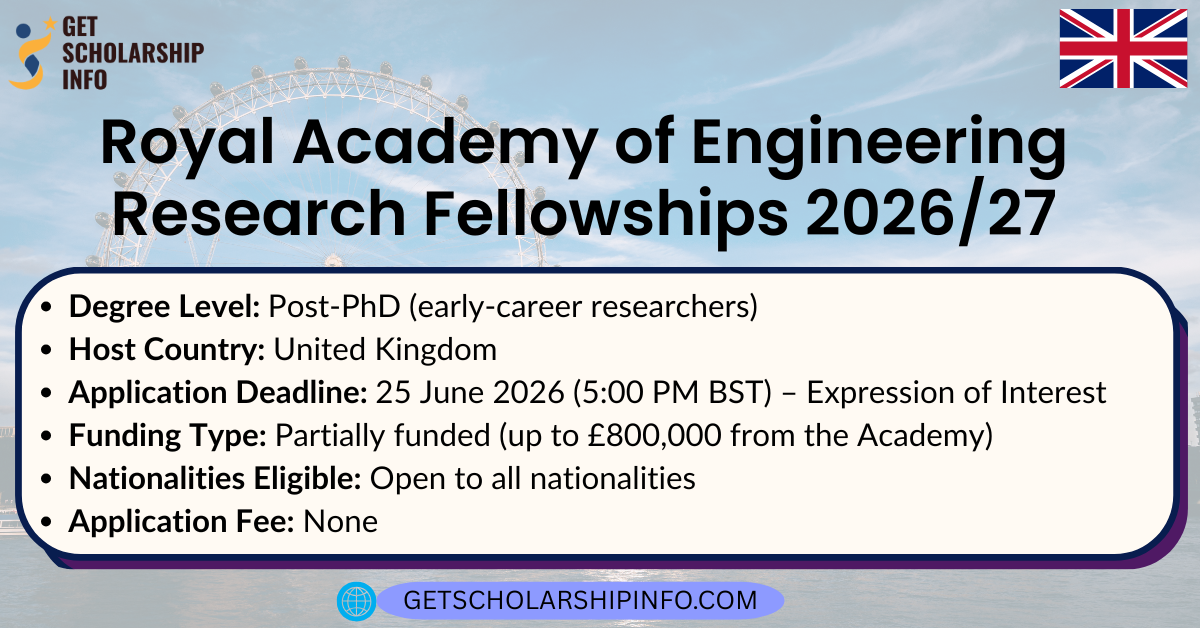
The Royal Academy of Engineering Research Fellowship is one of the UK’s most valuable funding schemes for early career engineering researchers, offering up to £800,000 in Academy contribution over five years to support an independent research programme at a UK university or eligible research organisation. It is worth being precise about what this actually is: a Research Fellowship, not a scholarship. A scholarship typically funds a student through a degree. This scheme instead funds an already qualified researcher, someone who holds a PhD, to run their own research programme as an employee of a host institution. That distinction matters because it changes who is eligible and what the money is actually for.
Who This Fellowship Is Actually For:
This scheme is aimed specifically at early career researchers who already hold a PhD in an engineering related field. To be eligible, your PhD must have been awarded, or unconditionally approved, no more than four years before the submission deadline. For the current round, an additional six month margin applies on top of that four year limit, so slightly older PhDs can still qualify without needing to justify extenuating circumstances. There are no nationality or age restrictions, and the Academy explicitly welcomes applications from underrepresented groups in UK engineering, including women and disabled researchers.
Engineering is interpreted broadly here. Eligible subject areas span civil, construction and environmental engineering; materials and mining; chemical and process engineering; aerospace; transport and mechanical engineering; manufacturing and design; electrical and electronic engineering; energy and power; medical and bioengineering; and computing and communications. Research spanning physics and other fundamental sciences closely tied to engineering applications can also qualify, provided the project fits within the Academy’s remit and is hosted at an eligible UK institution capable of receiving UKRI funding.
What the Fellowship Actually Provides:
Beyond the headline funding figure, the scheme includes several forms of support that make it more valuable than the raw monetary amount suggests:
- Up to £800,000 in Academy contribution over five years, calculated at 80 percent of full economic costs on a project costed up to £1 million
- Five years of full time funding, with part time fellowships available at a minimum of 50 percent full time equivalent
- One to one mentoring from an established Academy Fellow to support both the research and the researcher’s career development
- Reduced teaching and administrative duties at the host institution, freeing up genuine research time
- Access to additional training and funding opportunities through the Academy
- Networking access to the wider community of current and former Research Fellows and Academy Fellows, including the Academy’s ongoing CAFE (Connecting Awardees, Fostering Engagement) events
The five year funding horizon is unusually long for an early career award. Most postdoctoral funding in the UK runs two to three years at most, which makes this scheme genuinely attractive for researchers trying to build a stable, long term academic career rather than moving between short contracts. The scheme is funded by the Department for Science, Innovation and Technology and delivered by the Royal Academy of Engineering.
How Competitive Is This Fellowship:
This is a genuinely selective scheme. Recent rounds have seen roughly 130 applications competing for around 12 to 13 awards, putting the overall success rate at approximately 10 percent. That is demanding, but it also means a strong, well supported application has a real chance, particularly since applicants who were unsuccessful in a previous round are explicitly welcome to reapply and are considered fresh each time rather than penalised for a prior attempt.
Past Fellows and the Kind of Research This Funds:
Looking at who the Academy has actually funded helps make the scheme concrete rather than abstract. Recent cohorts of Research Fellows have worked on neurotechnologies, renewable energy systems, materials repurposing, soft robotics, and quantum technologies, alongside more applied projects tackling the energy efficiency of data centres, waste and recycling systems, and new approaches to treating medical conditions. The spread is intentionally wide: the Academy is not looking for one type of engineering, but for ambitious, high quality proposals across the full breadth of the field.
The Academy’s own overview of the scheme features researchers such as Dr Lidia Galdino and Dr Tawfique Hasan among its highlighted Fellows, reflecting the calibre of researcher the programme is designed to support and retain within UK academic engineering. If you want a sense of what a competitive proposal looks like in your specific subfield, the Academy’s news pages regularly publish profiles of newly announced Fellows and their funded projects, which are worth reading before you draft your own case for support.
The Two Stage Application Process:
Unlike a single application scheme, the Royal Academy of Engineering Research Fellowship runs a two stage process:
- Expression of Interest (EoI): A shorter initial application outlining the proposed research and the applicant’s background, submitted by the published deadline (25 June 2026 for the most recent round, closing at 5pm)
- Full application: Applicants who are successful at the Expression of Interest stage are then invited to submit a complete application, including a detailed case for support
Before either stage, most UK universities also run their own internal deadline, since institutions can typically only put forward a limited number of candidates for Academy consideration. This internal step usually happens one to two months before the Academy’s own Expression of Interest deadline, so if you are planning to apply through your current or prospective host institution, contact your department’s research funding office early rather than waiting for the Academy’s own deadline to approach.
If your proposed project needs funding beyond what the Academy provides, strong industry partners able to offer cash or in kind contributions can strengthen an application, though the core project must remain feasible without that additional support, and any extra funding cannot reduce the time you actually spend on the fellowship itself.
Eligibility Checklist:
- PhD awarded or unconditionally approved within the eligibility window before the submission deadline
- Proposed research project falls within engineering, broadly defined, across any of the Academy’s listed subject areas
- A confirmed or willing host institution that is eligible to receive UKRI funding and agrees to support you as it would a permanent employee
- No prior disqualifying attempt, since unsuccessful previous applicants are welcome to reapply and will be considered as new applications
How to Apply:
- Identify a UK host institution and, ideally, a department willing to support your application, since the fellowship is held at an institution rather than awarded directly to an individual with no affiliation
- Confirm your institution’s internal deadline and process, as most universities coordinate applications centrally rather than allowing direct individual submission to the Academy
- Prepare your Expression of Interest, including your research case and career history
- If successful at EoI stage, prepare the full application with a detailed case for support, budget, and supporting documentation
- Engage your named academic mentor and host department throughout, since institutional support is assessed as part of the application
Frequently Asked Questions?
Is this a scholarship for PhD students?
No. This is a Research Fellowship for researchers who already hold a PhD, intended to fund independent research as an early career academic rather than to fund a student through a degree.
How much funding does the fellowship provide?
Up to £800,000 in Academy contribution over five years, calculated at 80 percent of full economic costs on a project costed up to £1 million.
Can I apply if my PhD was awarded more than four years ago?
The standard limit is four years before the submission deadline, though the current round allows a further six month margin without requiring justification. Older PhDs may still be eligible with a documented explanation of extenuating circumstances such as career breaks.
Do I need a host university before I apply?
Yes. The fellowship is held at an eligible UK research organisation, and your application will typically go through your host institution’s own internal selection process before reaching the Academy.
Can I hold this fellowship part time?
Yes. Part time fellowships are available at a minimum of 50 percent full time equivalent, calculated pro rata against the standard five year duration.
Can international researchers apply?
Yes. There are no nationality restrictions, though the research must be hosted at an eligible UK institution.
How competitive is this fellowship?
Very. Recent rounds have received around 130 applications for approximately 12 to 13 awards, an overall success rate of roughly 10 percent.
