Nationality for All, an international human rights organization, ran its first-ever SEAP Fellows Programme this year, and it is worth a close look even though the application window has already shut. The fellowship brought on two early-career researchers to help update the Statelessness Encyclopedia Asia Pacific, a resource that documents nationality laws, legal identity systems, and exclusion across the region.
Applications closed on 25 May 2026, and selected fellows began their three-month placement on 15 June 2026. We are breaking down every detail here because NFA has stated this is meant to be an ongoing initiative, and understanding how the first round worked will help future applicants prepare early for the next call.
Why This Fellowship Stands Out From a Typical Scholarship:
Most opportunities featured on this site fund a degree or cover the cost of attending a university. This one is different. SEAP Fellows is a working fellowship rather than a study program, meaning selected candidates spend three months doing real research and editorial work for an established human rights organization instead of sitting in a classroom. If you are early in your career and want hands-on experience in human rights research rather than another academic credential, this is the kind of opportunity worth tracking closely.
Fellowship Overview:
- Fellowship Type: full-time, remote research fellowship, not a degree-based scholarship
- Organizing Body: Nationality for All (NFA), an international human rights organization
- Number of Positions: two fellows selected per cycle
- Geographic Focus: Southeast Asia, East Asia, and Central Asia, divided between the two fellows
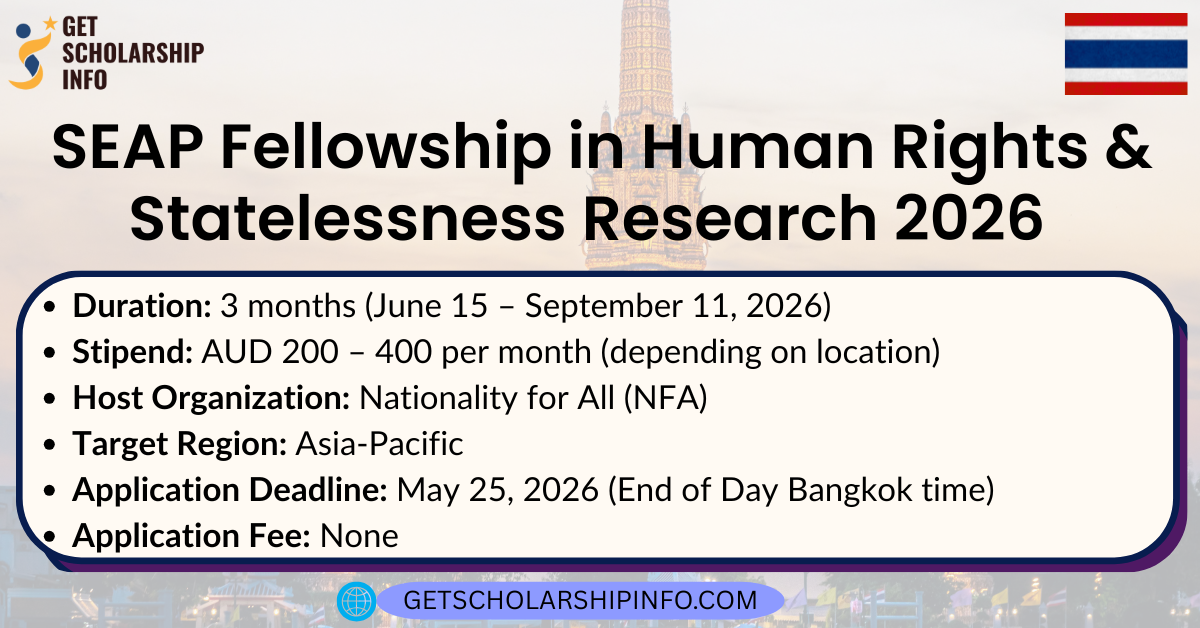
- Duration: three months, running from 15 June 2026 to 11 September 2026
- Stipend: AUD 200 to 400 per month, with the exact amount depending on the fellow’s location
- Application Deadline: 25 May 2026, by end of day Bangkok time
- Current Status: this round is closed, but the programme is expected to continue in future cycles
- Application Fee: none required
What This Program Is Actually Trying to Build:
SEAP stands for the Statelessness Encyclopedia Asia Pacific, and it is described by NFA as one of the most detailed regional resources tracking how statelessness affects people across Asia and the Pacific. The fellows brought on through this call were tasked with helping update the Second Edition of SEAP, which meant reviewing country-level factsheets, correcting outdated information, and strengthening the citation trail behind every claim published on the platform. This is not busywork. Researchers, policymakers, and civil society groups actually rely on SEAP as a reference point, so the fellows’ contributions feed directly into ongoing advocacy work across the region.
What Selected Fellows Gained From the Experience:
Because this is a working fellowship rather than a funded degree, the benefits look different from a typical scholarship. Selected fellows walked away with the following.
- Direct working experience with an international human rights organization, which strengthens a CV far more than classroom coursework alone
- A monthly stipend to support their time commitment during the three-month placement
- Structured training in factchecking methodology, citation systems, and website content management, all delivered through a dedicated guide and template
- Ongoing mentorship from NFA’s research team throughout the fellowship period
- Deeper subject-matter expertise in statelessness, nationality rights, and legal identity systems, an area with growing relevance in human rights and policy work
- A completed body of work they contributed to a recognized regional resource, something they can point to in future job or academic applications
- Flexibility to work independently from home, which suited applicants juggling other commitments alongside the fellowship
Who NFA Was Looking For:
Eligibility for this fellowship focused on skills and motivation rather than academic degrees or age limits, which sets it apart from most scholarship listings.
- Applicants needed strong desk research and analytical writing skills
- Attention to detail was treated as essential, given the factchecking and citation-heavy nature of the work
- Candidates had to be comfortable working independently, since the fellowship offered limited day-to-day supervision
- Reliability in meeting remote deadlines was listed as a core requirement
- A background in human rights, law, public policy, international relations, or a related discipline was expected
- Knowledge of citizenship rights, statelessness, or legal identity systems was considered highly desirable, though not mandatory
- Prior experience in research projects, human rights initiatives, or civil society organizations was preferred but not required
- Applicants with lived experience of statelessness were given priority consideration during selection
Areas of Focus Covered by the Fellowship:
- Statelessness Research
- Nationality Rights and Citizenship Law
- Legal Identity Systems
- Human Rights Research Methodology
- Public Policy and International Relations
How the Three Months Were Structured:
One detail that made this fellowship easier to plan around was its clear month-by-month breakdown, rather than an open-ended list of tasks.
- Month One centered on onboarding, orientation, and training in factchecking methodology, citation systems, and website updating tools, followed by the start of factchecking work on each fellow’s assigned sub-region
- Month Two shifted toward updating SEAP’s website content and revising report materials, with fellows coordinating directly with the NFA team to keep edits consistent
- Month Three focused on integrating and verifying citations across the website, followed by a final round of accuracy and consistency checks before the fellowship wrapped up
The Application Process NFA Used:
- Applicants had to prepare a CV, a cover letter, and one original writing sample
- All materials were submitted by email directly to info@nationalityforall.org
- The subject line had to read “Application – SEAP Fellows 2026” exactly as specified
- No online portal or separate account creation was required, which kept the process fairly lightweight
- The final deadline was set at end of day Bangkok time on 25 May 2026
What This Tells Us About Future Cycles:
NFA framed this fellowship as part of its ongoing work on SEAP, not a one-time initiative, which suggests future rounds are likely. If you are interested in human rights research and missed this cycle, it is worth bookmarking NFA’s official channels and preparing your writing sample and cover letter well in advance. Given how specific the eligibility criteria were around desk research skills and subject knowledge, candidates who already have some background in law, policy, or human rights work will likely have a real advantage whenever the next call goes out.
Why the Priority for Lived Experience Matters:
One detail worth highlighting separately is NFA’s explicit preference for applicants with lived experience of statelessness. This is not a common feature in most fellowship or scholarship listings, and it reflects a broader shift happening across the human rights sector, where organizations increasingly recognize that people directly affected by an issue often bring insights that outside researchers simply cannot replicate. If you or someone in your network has this kind of background, it is worth highlighting clearly in any future application to a similar program.
Frequently Asked Questions?:
Is the SEAP Fellows application still open? No. The 2026 cycle closed on 25 May 2026, and the selected fellows have already begun their three-month placement.
Is this a paid fellowship? Yes, though modestly. Fellows receive a monthly stipend ranging from AUD 200 to 400 depending on their location.
Do I need a specific degree to apply? No specific degree is required, but a background in human rights, law, public policy, or international relations is expected.
Is the fellowship remote or in person? It is a full-time remote fellowship, though occasional in-person meetings may be organized when necessary.
How many fellows are selected each cycle? Two fellows are selected per cycle, with the assigned sub-regions divided between them.
Is there an application fee? No, there is no fee to apply for this fellowship.
Will NFA run this fellowship again? The fellowship is described as part of NFA’s ongoing SEAP work, which suggests future cycles are likely, though no confirmed date has been announced yet.
