Harvard Radcliffe Institute has opened its fellowship application for the 2027-2028 academic year, and it is one of the more unusual opportunities you will come across on this site, since it is not aimed at students at all. This program is built for scientists, writers, scholars, public intellectuals, and artists who already have real accomplishments behind them and want a full year to push a single ambitious project forward, supported by Harvard’s resources and an interdisciplinary community of fellow thinkers and creators.
The fellowship comes with a stipend, project funds, office or studio space, and a full Harvard appointment, and it is open to applicants from any country, not just the United States. There is no listed application fee, but the eligibility bar is high, since you generally need several years of professional accomplishment behind you before you can even apply.
Not a Student Scholarship, and That Matters:
If you came here expecting tuition support or a degree program, this is worth pausing on. The Radcliffe Fellowship exists to give accomplished professionals dedicated time and space to complete meaningful work, not to fund someone’s education. Applicants must already hold a doctorate or an equivalent terminal achievement in their field, and current degree-program students cannot apply at all. Think of it less as financial aid and more as a paid sabbatical inside one of the world’s most resource-rich academic environments.
Fellowship Snapshot:
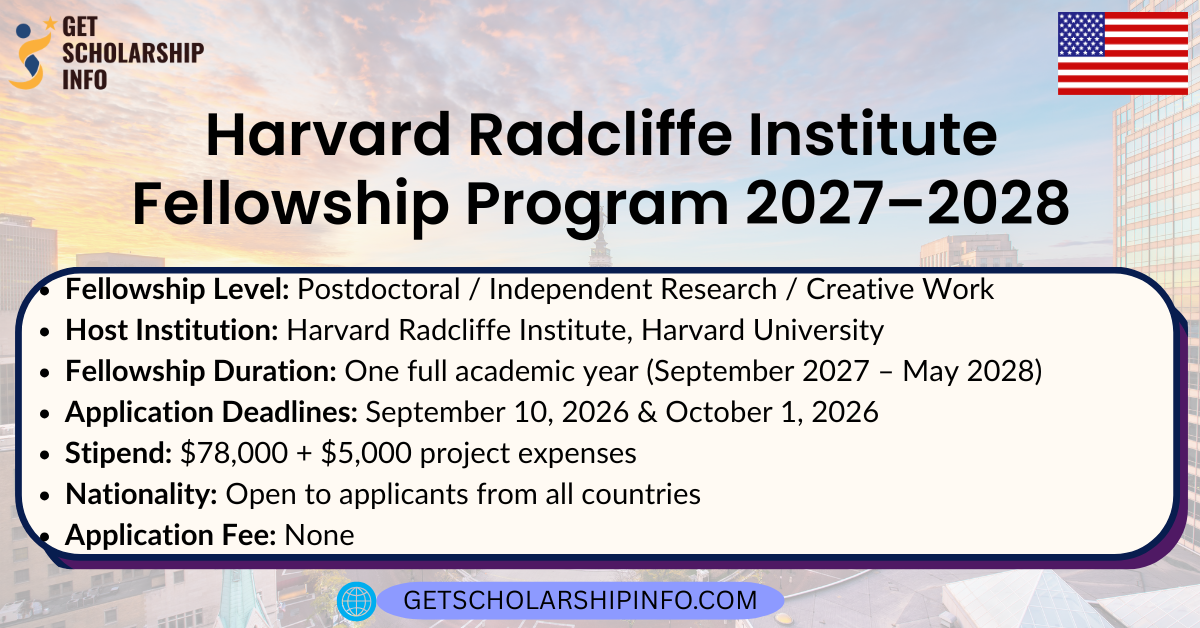
- Program Type: a full academic year, non-degree research and creative fellowship
- Host Institution: Harvard Radcliffe Institute, part of Harvard University, located in Cambridge, Massachusetts
- Fellowship Year: 2027-2028, running from September through May
- Deadline for Humanities, Social Sciences, Creative Arts, Nonfiction, and Journalism: 10 September 2026, 5 PM ET
- Deadline for Science, Engineering, and Mathematics: 1 October 2026, 5 PM ET
- Application Fee: none mentioned in the official guidelines
- Nationality Requirement: open globally, with no restriction to United States citizens or residents
- Relocation Requirement: fellows must reside in the Cambridge/Boston area for the full academic year
What Fellows Actually Receive:
This is where the Radcliffe Fellowship stands apart from almost anything else on this site. The support package is substantial and covers far more than a token stipend.
- An annual stipend of $78,000 to support living costs during the fellowship year
- An additional $5,000 specifically allocated to cover project-related expenses
- Potential relocation, housing, and childcare funds to help fellows transition smoothly into life at Radcliffe
- Healthcare support made available as needed throughout the fellowship period
- Dedicated office or studio space inside Byerly Hall, located in the historic Radcliffe Yard
- A full-time Harvard appointment as a visiting fellow, which unlocks access to the entire Harvard Library system and university athletic facilities
- Ongoing professional development and engagement opportunities woven throughout the fellowship year
- Membership in a genuinely interdisciplinary community, including weekly fellows’ talks, workshops, and social events designed to connect scholars and artists across completely different fields
The Research Focus Radcliffe Is Prioritizing:
Every fellowship cycle at Radcliffe reflects certain thematic priorities, and this one is no exception. The Institute is especially interested in proposals that confront pressing social, scientific, and policy issues while engaging audiences beyond the walls of academia. True to its history, Radcliffe continues to welcome projects centered on women, gender, and society, or ones that draw on the Schlesinger Library’s extensive archival collections, though these are not required themes.
The current multiyear focus area, running from 2024 through 2029, centers on academic freedom and connecting across difference, touching on intellectual virtues, open inquiry, political polarization, inequality, religious pluralism, and the broader role of higher education in public life. Alongside this, Radcliffe has specifically added a call for proposals in science, technology, engineering, and mathematics that have been directly affected by federal research funding cuts, which reflects a real and current concern in the research community.
Who Can Apply:
Eligibility at Radcliffe is not based on age, nationality, or degree level in the usual sense. Instead, it is based entirely on career accomplishment within your chosen discipline, and the exact bar shifts depending on your field.
- Applicants in the humanities and social sciences must have earned their doctorate or equivalent terminal degree at least four years before their fellowship appointment, and must have published a monograph or at least two articles in refereed journals or edited collections
- Applicants in science, engineering, and mathematics must also hold a doctorate earned at least four years prior, along with at least five published articles in refereed journals, though most successful applicants in this category have published far more
- Applicants in journalism must have worked professionally as a journalist for a minimum of five years
- Applicants in nonfiction must have at least one published book, a signed contract for a book-length manuscript, or a minimum of three shorter published works
- Applicants in fiction follow the same standard as nonfiction, requiring a published book, a manuscript contract, or several shorter published works
- Applicants in poetry must have published at least 20 poems or a full book of poetry within the past five years, and must currently be working on a manuscript
- Applicants in playwriting need a significant independent body of work, typically including plays that have been produced or are currently under option
- Applicants in film and video must show a body of independent work that has been exhibited in galleries, screened at festivals, or broadcast on television
- Applicants in visual arts need at least five years of professional experience, including participation in curated group shows and at least two solo exhibitions
- Applicants in music composition are not required to hold a PhD or DMA, but must demonstrate strong professional achievement through a record of recent performances
It is also worth noting clearly that this fellowship does not function as a postdoctoral program, so anyone currently enrolled in a degree program cannot apply. Former Radcliffe fellows, going all the way back to 1999, are also ineligible to apply again.
Fields and Program Areas Covered:
- Humanities and Social Sciences
- Science, Engineering, and Mathematics
- Creative Arts
- Nonfiction and Journalism
What You Need to Prepare:
The application itself is detailed, and each piece plays a specific role in how reviewers assess your proposal.
- A completed application form submitted through Radcliffe’s online portal
- An up-to-date curriculum vitae
- A 1,400-word project proposal, including a bibliography where relevant to your field
- A writing or work sample, with format and length requirements that vary depending on your discipline
- Contact information for three references, who will be emailed directly and asked to upload their letters of recommendation
Work Sample Requirements by Discipline:
Since the work sample carries real weight in the review process, it helps to know exactly what reviewers expect from your specific field.
- Humanities and social sciences applicants should submit relevant writing connected to their proposed project, whether published or not, up to a maximum of 40 pages
- Science, engineering, and mathematics applicants should submit three published articles
- Nonfiction applicants should submit around 30 pages of related material, such as a book chapter, short story, manuscript, or article
- Journalism applicants should submit three substantive published articles totaling around 30 pages, with the option to include up to 15 minutes of audio or video work
- Fiction applicants should submit roughly 30 pages of recent, related material
- Poetry applicants should submit up to 10 poems
- Playwriting applicants should submit one play or a section of a play, no longer than 30 pages
- Visual arts applicants should submit 12 images, along with up to three moving-image excerpts if applicable
- Film and video applicants should submit no more than 15 minutes of work, with timestamps provided if the full sample runs longer
- Music composition applicants should submit one to three recent compositions, accompanied by written scores unless the work is electronic or improvisational
How the Review Process Works:
Radcliffe uses a two-tiered evaluation system rather than a single review committee. Your application is first assessed by experts within your specific field, and then it moves to a multidisciplinary committee tasked with selecting a diverse group of fellows who show both strong achievement and real potential. Throughout this process, Radcliffe places real weight on collegiality, meaning reviewers are also considering how well a candidate might engage with fellows working in entirely different disciplines, since that cross-pollination is central to how the Institute operates.
How to Apply Step by Step:
- Create a new account on Radcliffe’s application platform using your name, email address, and a password
- Log into the Online Fellowship Application Portal once your account is active
- Select your application area from the four available options: Humanities and Social Sciences, Creative Arts, Nonfiction and Journalism, or Science, Engineering, and Mathematics
- If your project spans multiple disciplines, choose the primary area that best matches your background and eligibility, and use the secondary designation field to reflect the interdisciplinary nature of your work
- Complete all sections of the application form and upload your CV, project proposal, and work sample
- Provide contact details for three references, who will receive an automated email prompting them to upload their recommendation letters
- Submit everything before your discipline’s specific deadline, since the two deadlines differ by discipline group
Life as a Fellow:
Being selected is not a remote or flexible arrangement. Fellows are required to relocate to and live in the Cambridge or Boston area for the entire fellowship period, from September through May, so they can genuinely participate in the fellowship community. This includes attending weekly talks given by fellow cohort members, professional development workshops, and various social events built into the program. Radcliffe treats this in-person community as a core part of what makes the fellowship valuable, not an optional add-on.
When You Will Hear Back:
All applicants receive notification of their application outcome by email, with results expected by the end of March 2027. Given the scale of the review process, involving both discipline-specific experts and a multidisciplinary committee, this waiting period reflects how carefully each proposal gets considered before a final decision is reached.
Frequently Asked Questions?:
Is the Radcliffe Fellowship open to international applicants? Yes. There is no nationality restriction, and applicants from any country can apply.
Is there an application fee? No fee is mentioned in the official application guidelines.
Can current PhD students apply? No. This fellowship is not designed as a postdoctoral program, and anyone currently enrolled in a degree program is ineligible.
What is the stipend amount? Fellows receive a $78,000 stipend plus an additional $5,000 for project expenses, along with potential relocation, housing, and childcare support.
Do fellows need to relocate to Harvard? Yes. Fellows must live in the Cambridge/Boston area for the full academic year to participate in the fellowship community.
What are the application deadlines? Humanities, social sciences, creative arts, nonfiction, and journalism applications are due 10 September 2026, while science, engineering, and mathematics applications are due 1 October 2026.
Can former Radcliffe fellows apply again? No. Anyone who has previously held a Radcliffe fellowship since 1999 is not eligible to reapply.
Also Check: Rowland Fellows Program 2027 at Harvard University
