Clean water. Climate resilience. Flood protection. These are not abstract problems for small island nations and developing countries , they are daily realities that shape how people live, farm, and survive. IHE Delft Institute for Water Education in the Netherlands has built its entire academic reputation around solving exactly these challenges, and now it is opening its doors to students from some of the world’s most climate-vulnerable nations through the Water and Development Partnership Programme (WDPP).
This is not a small opportunity. Funded directly by the Dutch Ministry of Foreign Affairs, the scholarship covers a full Master’s degree in Water and Sustainable Development at one of Europe’s most respected water research institutions. Tuition, travel, insurance, and a monthly living allowance are all included for those who qualify for the full award, while partial support is also available for candidates who can bring some funding of their own.
Below, I have broken down everything you need to know ; who can apply, what exactly you get, how the selection works, and the steps to submit a strong application before the deadline closes.
Key Details:
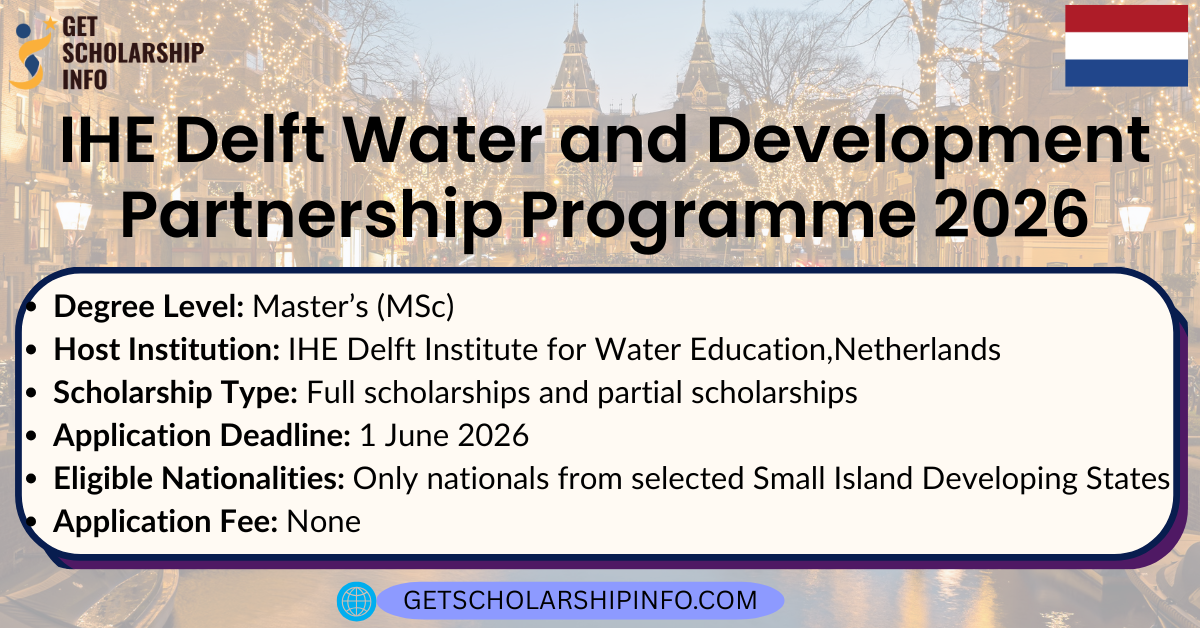
- Scholarship Name: Water and Development Partnership Programme (WDPP), offered through IHE Delft
- Degree Level: Master of Science (MSc) in Water and Sustainable Development (regular or research track)
- Host Institution: IHE Delft Institute for Water Education, Netherlands
- Funding Type: Full scholarship and partial scholarship options available
- Application Deadline: 1 June 2026
- Results Announcement: 1 July 2026
- Application Fee: No separate application form or fee is required for this specific scholarship
- Nationality Requirement: Restricted to nationals of specific eligible countries listed below
- Language Requirement: English proficiency test required, with exemptions for a few countries
What This Scholarship Offers:
When people read scholarship pages, they usually want to know one thing first: what do I actually walk away with? So let’s talk about that in plain terms.
If you are awarded the full scholarship, your entire academic journey at IHE Delft is taken care of financially. You will not need to worry about tuition bills piling up, because the programme pays the complete cost of the MSc. Your health insurance during your stay in the Netherlands is included too, which means you can focus on your coursework and research instead of budgeting for medical costs in a new country.
International travel is also covered, so getting from your home country to the Netherlands (and back) will not eat into your personal savings. On top of that, you receive a monthly allowance of €1,220 to cover your cost of living and accommodation for the entire duration of your studies. This is enough to rent a room, cover food, and manage daily expenses in the Netherlands without financial stress hanging over your head.
Beyond the money, there’s something arguably more valuable here: a direct link back to your own country. Unlike many scholarships that simply train you and send you off, this one is designed so your research actually benefits your home region. You will carry out your MSc research in your own country, tied to a real project the programme is already supporting there. That means your work isn’t just an academic exercise sitting in a thesis drawer , it feeds into ongoing water and development work that matters locally.
You also become part of a learning network of water professionals across the focus regions of the programme. This is a chance to build relationships with peers and experts working on similar water challenges in other Small Island Developing States and vulnerable regions, something that can open doors long after your degree is finished.
If full funding is not something you can secure, the partial scholarship route still gives you meaningful support, and if you’re able to bring in some funding from your employer or another source, you may qualify for additional funds to cover the rest.
Who Can Apply: Eligible Countries:
This scholarship is not open to everyone worldwide. It specifically targets nationals of countries that are Small Island Developing States or partner regions under the Dutch programme. If your country is not on this list, you will not be eligible, so check carefully before you start your application.
Eligible nationalities include: Belize, Cabo Verde, Comoros, Cuba, Dominica, Dominican Republic, Fiji, Grenada, Guinea-Bissau, Guyana, Haiti, Jamaica, Kiribati, Maldives, Marshall Islands, Mauritius, Federated States of Micronesia, Montserrat, Nauru, Niue, Palau, Papua New Guinea, Saint Lucia, Saint Vincent and the Grenadines, Samoa, Sao Tome and Principe, Solomon Islands, Suriname, Timor-Leste, Tonga, Tuvalu, and Vanuatu.
Eligibility Criteria:
Meeting the nationality requirement alone is not enough. Here is what else you need to satisfy before you can be considered:
- You must first gain academic admission to either the regular or research variant of the MSc in Water and Sustainable Development
- You must currently be living and/or working in one of the eligible countries listed above
- You need to agree, in advance, to carry out your MSc research in your home country or region, tied to a project already supported by the programme there
- You are expected to actively take part in and contribute to seminars organized under the programme’s learning networks
- You must confirm your intention to return to your country of origin, or another priority country of the programme, after finishing your studies
- One of your two required recommendation letters must come from your current employer, and it must meet specific conditions explained below
The Employer Recommendation Letter Requirement:
This part trips a lot of applicants up, so pay close attention. Out of the two recommendation letters you submit with your admission application, one absolutely must be from your current employer, and it has to be written a certain way for you to even be considered for this scholarship.
The letter needs to:
- Be printed on official company letterhead
- Carry a clear date and an authorized signature
- Explain how the skills and knowledge you gain from this MSc will directly benefit your employer’s work and performance
- Confirm that you are expected to return to your job at the organization once your studies are complete
- Mention which project(s) funded by the Water and Development Partnership Programme your employer is involved in, if applicable
If your employer letter does not meet these conditions, you simply will not be considered for this particular scholarship track, even if you meet every other requirement. So it’s worth having an honest conversation with your employer early, well before the deadline, so they have time to prepare a proper letter.
Programs Available:
This scholarship funds study in the following field:
- Water and Sustainable Development
Selection Priorities: What Makes an Application Stand Out:
Because funding is limited, IHE Delft and the Dutch Ministry don’t just pick names at random. There are clear priorities that shape who gets selected:
- Female candidates are given strong priority under this programme
- Applicants need to show genuine, strong motivation, since the online application requires answering five separate motivation questions
- A solid academic record works in your favor
- Candidates who already have relevant work experience in the water or development sector are preferred
- If two candidates are equally strong and eligible, priority goes to the one who can bring in some co-funding from another source, such as an employer or another scholarship
Given how competitive this can get, it’s genuinely a good idea to also apply for other scholarships you might be eligible for at the same time, including ones that only cover part of the cost. The programme itself advises this, and specifically mentions that candidates eligible for the Rabbani scholarship should apply for that as well, just to widen their chances.
English Language Requirement:
Almost every international scholarship comes with a language condition, and this one is no different. You will need to submit results from an approved English language test as part of your final admission and scholarship eligibility.
Here’s the part that matters most: if your English test results are not submitted before 1 June 2026, you lose your eligibility for the scholarship entirely, regardless of how strong the rest of your application is. So don’t leave this until the last week.
There is one exception. If you’re a national of Belize, Guyana, Jamaica, or Saint Vincent and the Grenadines, you are exempted from submitting an English test score.
How to Apply:
Here’s something that surprises a lot of applicants: there is no separate application form for this particular scholarship. You don’t fill out a different document or submit a separate scholarship request.
Instead, the process works like this:
- Apply for admission to the MSc in Water and Sustainable Development at IHE Delft, choosing either the regular or research variant
- Make sure your recommendation letters include one from your employer that meets the specific requirements listed earlier in this post
- Submit your English language test results before 1 June 2026, unless you belong to one of the exempted nationalities
- Once you receive your academic admission letter, you will be automatically considered for the WDPP scholarship if you meet the nationality and eligibility conditions
- Wait for the outcome, which will be announced on 1 July 2026
Because admission itself takes time to process, apply as early as possible rather than waiting until close to the deadline. Give yourself room to fix any documentation issues, especially around the employer letter and English test scheduling.
Important Dates to Remember:
- Application deadline: 1 June 2026
- English test results deadline: 1 June 2026
- Scholarship outcome announcement: 1 July 2026
Frequently Asked Questions?:
Is the IHE Delft WDPP scholarship fully funded?
Yes, the full scholarship covers tuition, insurance, international travel, and a monthly living allowance of €1,220. Partial scholarships are also available for applicants who can secure some funding from another source.
Do I need to submit a separate scholarship application form?
No. You only need to apply for admission to the MSc programme. If you meet the nationality and eligibility criteria, you are automatically considered for this scholarship once you receive your admission letter.
Which countries are eligible for this scholarship?
Nationals from a specific list of Small Island Developing States and partner countries are eligible, including Haiti, Fiji, Jamaica, Maldives, Papua New Guinea, and several others listed in the eligibility section above.
Is there an application fee for this scholarship?
No separate fee applies specifically to the scholarship process. It runs alongside your regular admission application.
What happens if I don’t submit my English test on time?
If your English test results are not submitted before 1 June 2026, you become ineligible for the scholarship, even if the rest of your application is strong.
Can male candidates apply for this scholarship?
Yes, but female candidates are given strong priority in the selection process due to the programme’s focus on gender balance in the water sector.
Do I need work experience to apply?
Work experience is not strictly mandatory, but candidates with relevant experience in water or development-related fields are preferred during selection.
Will I need to return to my home country after graduation?
Yes, one of the core conditions is that you confirm your intention to return to your country of origin or another priority country of the programme after completing your studies.
