
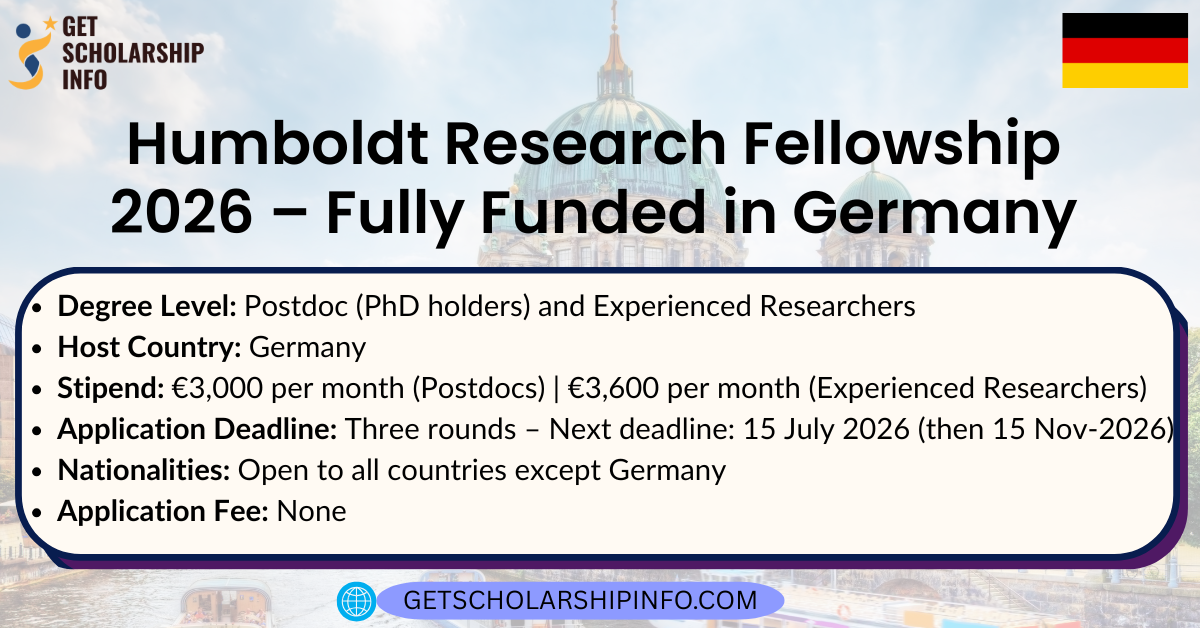
The Humboldt Research Fellowship, offered by the Alexander von Humboldt Foundation, funds highly qualified researchers from anywhere in the world to carry out an independent research project in Germany, in cooperation with a host of their own choosing at a German university or research institution. It is one of the most prestigious research fellowships available internationally, with an alumni network that includes thousands of researchers and multiple Nobel laureates. Unlike most scholarships covered on this site, it does not run on a single annual deadline. Applications are accepted on a rolling basis throughout the year, and understanding that structure is the key to applying at the right time for you.
There Is No Fixed Deadline: Here Is How It Actually Works
This is worth explaining clearly, since it is the single most misunderstood part of this fellowship. The Humboldt Foundation’s selection committee meets three times a year, in March, July, and November, to review completed applications. There is no cutoff date by which you must submit. Instead, you prepare and submit your application whenever it is genuinely ready, and it is considered at whichever upcoming committee meeting is realistically reachable given processing time.
Processing a complete application, including the host statement and required referee reviews, typically takes four to eight months from submission to decision. In practice, this means if you want to be considered at the November committee meeting, you should have your complete application, including your host’s confirmation and your referees’ reviews, submitted several months earlier, not in the days before November arrives. Applying well in advance of your target round matters far more here than for a fixed deadline scholarship, since a late or incomplete submission simply gets pushed to the following round rather than rejected outright.
Eligibility:
The fellowship operates across two distinct tracks, and eligibility depends on which one applies to you:
- Postdoctoral researchers: must have completed their doctorate no more than four years before the date of application
- Experienced researchers: must have completed their doctorate no more than twelve years before the date of application, and have already established an independent research profile
Both tracks are open to researchers of all nationalities and all research areas. Foreign applicants are generally expected to have lived outside Germany for a minimum of 12 months in total prior to applying. Before applying, you must also have already agreed on a detailed research outline, including your intended host institution and expected duration, with your chosen academic host in Germany. Short visits for training, study, or attending conferences are not eligible under this fellowship.
What the Fellowship Actually Pays:
- A monthly stipend of €3,000 for postdoctoral researchers, or €3,600 for experienced researchers
- A fellowship duration of 6 to 24 months for postdoctoral researchers, or 6 to 18 months for experienced researchers, which can be split into up to three separate research stays within a three year window
- A family allowance of approximately €340 per month if a spouse or partner accompanies you to Germany for at least three months
- An additional allowance of approximately €270 per month for each accompanying child under 18
- A lump sum travel allowance covering travel expenses connected to the fellowship
- A fully funded intensive German language course for fellows and their accompanying partner before the fellowship begins
- Individual mentoring support throughout the entire sponsorship period, not only during the research stay itself
Why the Flexibility Here Is Actually a Feature:
Most fellowships lock you into a fixed start date shortly after selection. Humboldt does not. Once approved, fellows have real flexibility in choosing their actual start date, and experienced researchers in particular can split their fellowship into up to three separate visits across three years rather than one continuous stay. This makes the fellowship genuinely workable for researchers who cannot simply drop an existing position or teaching commitment for a year or two in one uninterrupted block.
The Humboldt Network: What You Actually Join
The stipend and research time are only part of what this fellowship provides. Once accepted, you become a Humboldtian, part of a global community the Foundation describes as the Humboldt Family, currently made up of sponsorship recipients and alumni from more than 140 countries. That network includes 63 Nobel Prize laureates among its ranks, alongside tens of thousands of researchers across every academic discipline, drawn from a total alumni base of roughly 30,000 sponsorship recipients worldwide.
What makes this genuinely different from simply listing a fellowship on your CV is that the Foundation stays involved for the long term rather than ending its relationship with you once the funded stay is over. Humboldtians remain eligible for return visit grants to continue German collaborations well after the original fellowship ends, and the Foundation runs ongoing network events connecting fellows and alumni across countries and career stages. The Foundation describes this directly as supporting fellows and award winners for their entire lifetime, not only for the duration of the funded project.
In practical terms, this means a Humboldt Fellowship can open doors well beyond the research you complete during your fellowship itself, through introductions, collaboration opportunities, and continued funding access that come from being part of an active, decades old international research community rather than a one time grant.
How to Apply:
- Identify a research topic and a specific academic host at a German university or research institution, and agree the details of your research outline together before applying, since this cannot be arranged after submission
- Confirm which track applies to you based on how long ago you completed your doctorate
- Prepare your application materials, including your research proposal and CV
- Arrange for your host institution to submit a host statement, including a confidential assessment and confirmation of research facilities
- Arrange expert reviews from your doctoral supervisor and one additional qualified reviewer of your choosing
- Submit your complete application well ahead of whichever committee meeting (March, July, or November) you are realistically aiming for, accounting for the four to eight month processing window
Frequently Asked Questions?
When is the deadline for the Humboldt Research Fellowship?
There isn’t a fixed deadline. Applications are accepted on a rolling basis, and a selection committee reviews completed applications three times a year, in March, July, and November. Submit whenever your application is genuinely complete, well ahead of your target committee meeting.
How long does the application take to process?
Typically four to eight months from a complete submission to a decision, which is why timing your submission around the three annual committee meetings matters more than any single calendar deadline.
How much does the fellowship pay?
€3,000 per month for postdoctoral researchers, or €3,600 per month for experienced researchers, plus family allowances, a travel allowance, and a fully funded German language course.
Can I split my fellowship into multiple visits instead of one continuous stay?
Yes. Fellows can divide their research stay into up to three separate visits within a three year window rather than completing it in one uninterrupted block.
Do I need to already have a host in Germany before applying?
Yes. You must agree on a detailed research outline, including your intended host and duration, with your chosen academic host before submitting your application.
What happens if my application is rejected?
Decisions cannot be appealed, but applicants may reapply if they substantially strengthen key parts of their application. Applications rejected unanimously by the committee are subject to a minimum 18 month waiting period before reapplying.

Postdoc
Yes, this fellowship is open to postdoctoral researchers. If you have completed your PhD within the last 4 years and can secure a host researcher in Germany, you may be eligible to apply.